⚠️This case study focuses on the product strategy, design decisions, and business outcomes behind the work. Detailed product visuals are currently unavailable, but will be added in a future update.

Designing an ESG Operating System
Helping organizations transform sustainability commitments into measurable action.
Company
Planted
Role
Senior Product Designer
Timeline
2024 – Present
Product
ESG SaaS Platform
🌍Context
Planted is an ESG management platform that helps organizations transform sustainability commitments into measurable action.
Companies face increasing pressure from regulations, stakeholders, and customers to define, execute, and report on their sustainability strategies. This often involves managing complex structures, large amounts of data, and multiple organizational entities.
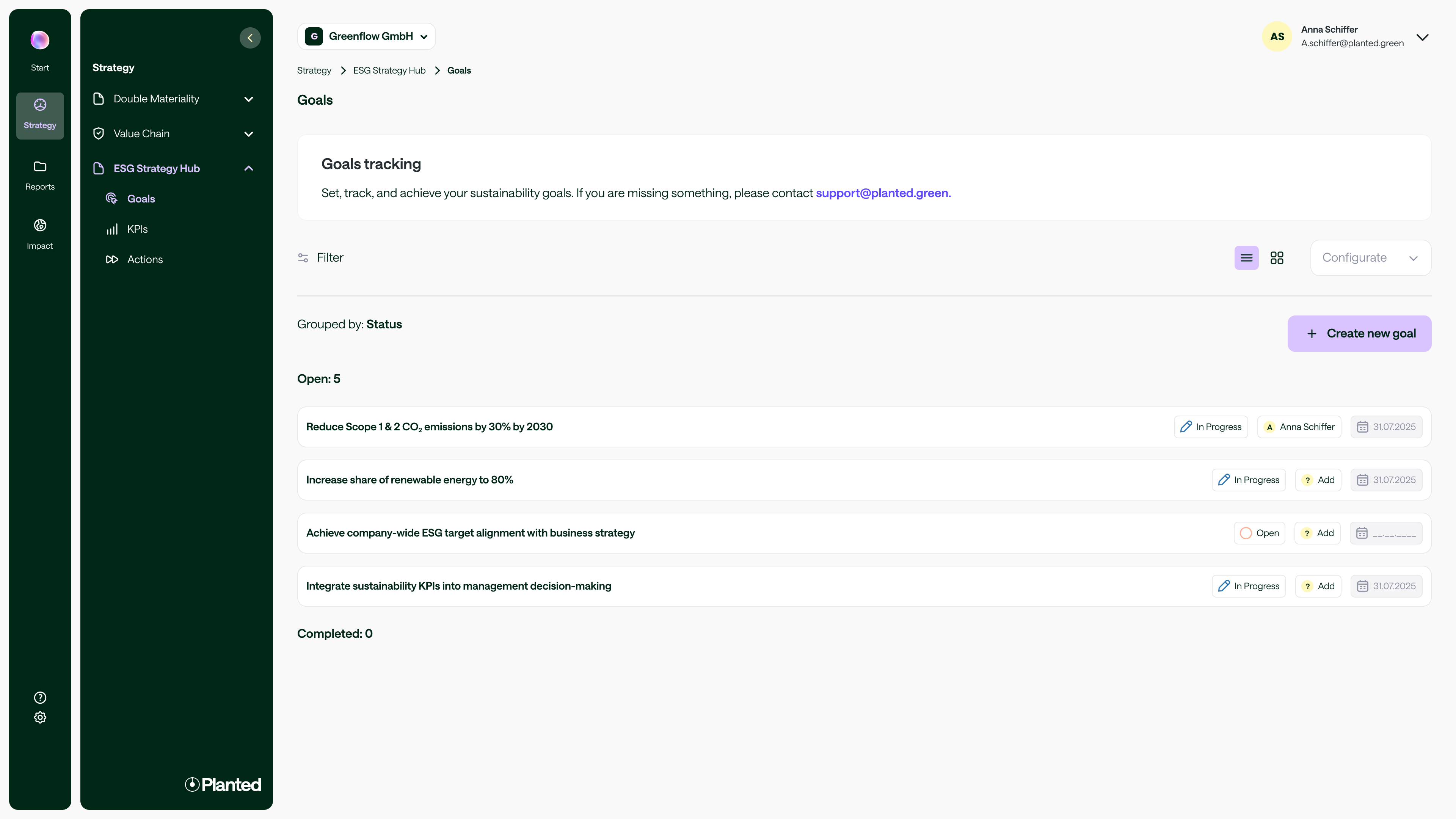
Several strategic initiatives focused on connecting goals, actions, KPIs, emissions reduction planning, and reporting into a unified ESG workflow, helping organizations move from ambition to execution.
Contributions
- •Product discovery and problem framing
- •UX strategy and information architecture
- •User flows and systems design
- •Feature conception and validation
- •UI design and prototyping
- •Stakeholder alignment and design QA
🦸My Role
I led ESG product strategy and design at Planted, working across strategy, research, and systems design to help organizations operationalize sustainability at scale. This involved discovering user needs across diverse stakeholder groups, building information architecture for complex ESG workflows, and designing scalable solutions that balance strategic planning with operational execution.
- •ESG product strategy and vision
- •User research and discovery across stakeholder groups
- •Information architecture and UX strategy
- •Feature conception and design systems
- •Stakeholder alignment and executive storytelling
- •Design leadership and mentorship
✨Design Principles
Make complexity manageable
Transform complex ESG processes into intuitive workflows that users can understand and navigate with confidence.
Connect strategy with execution
Bridge the gap between sustainability ambitions and operational activities through structured planning and measurable outcomes.
Design for scalability
Create solutions capable of supporting both small organizations and complex multi-entity structures.
Build trust through clarity
Present sustainability information in a transparent and understandable way to support confident decision-making.
Make complexity manageable
Transform complex ESG processes into intuitive workflows that users can understand and navigate with confidence.
Connect strategy with execution
Bridge the gap between sustainability ambitions and operational activities through structured planning and measurable outcomes.
Design for scalability
Create solutions capable of supporting both small organizations and complex multi-entity structures.
Build trust through clarity
Present sustainability information in a transparent and understandable way to support confident decision-making.
⭐Key Initiatives
Building the ESG Strategy Hub
🧗 Challenge
Organizations often struggled to connect sustainability goals, initiatives, and performance metrics within a coherent framework.
✨ Approach
A structured system was introduced to connect Goals, Actions, and KPIs, enabling organizations to move from strategic planning to measurable execution within a single workflow.
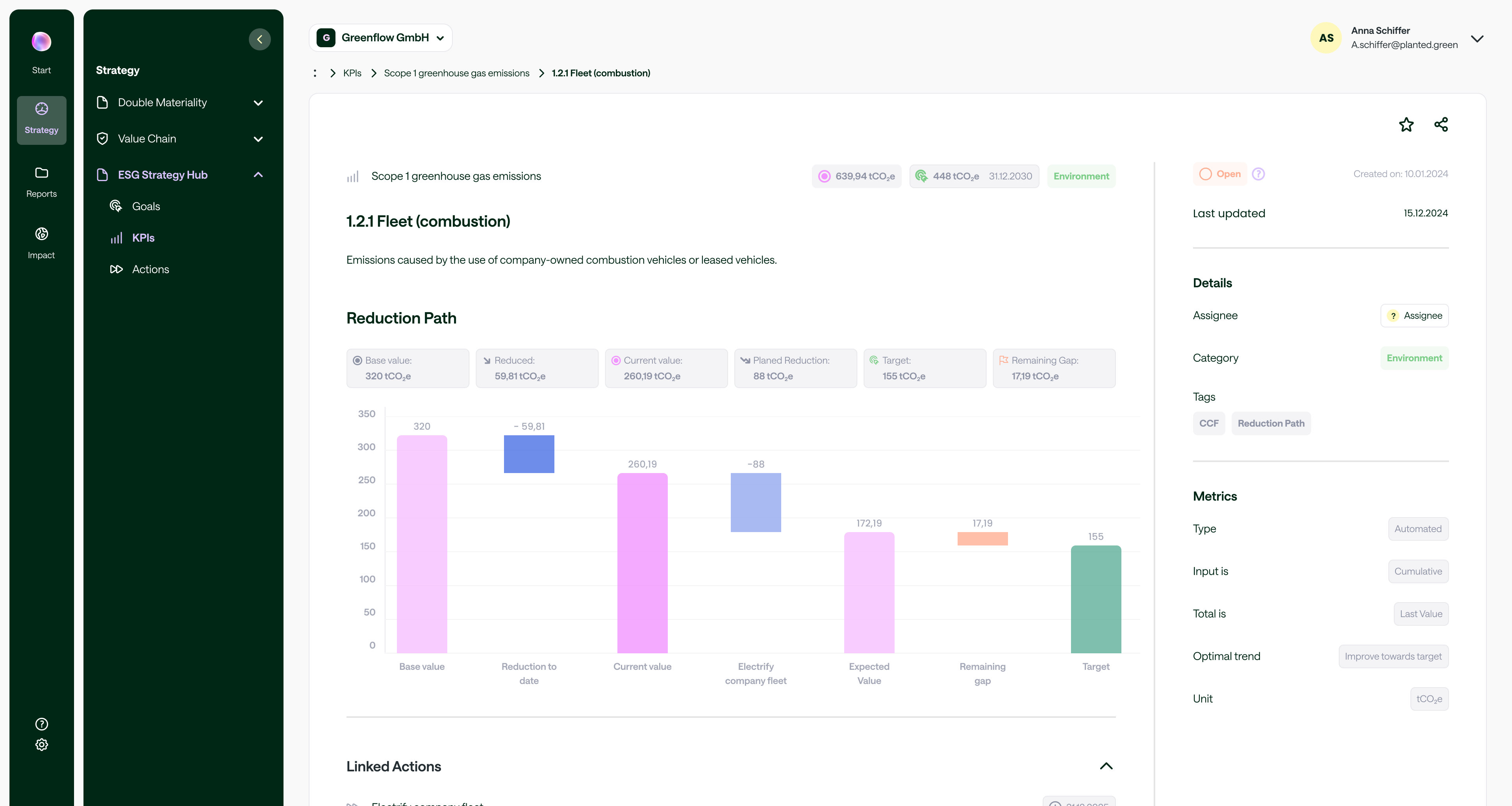
Making Emissions Reduction Actionable
🧗 Challenge
Emission reduction targets frequently remained high-level commitments without a clear path to implementation.
✨ Approach
The Reduction Path experience enabled organizations to model reductions across scopes, categories, and emitters while providing visibility into progress over time.
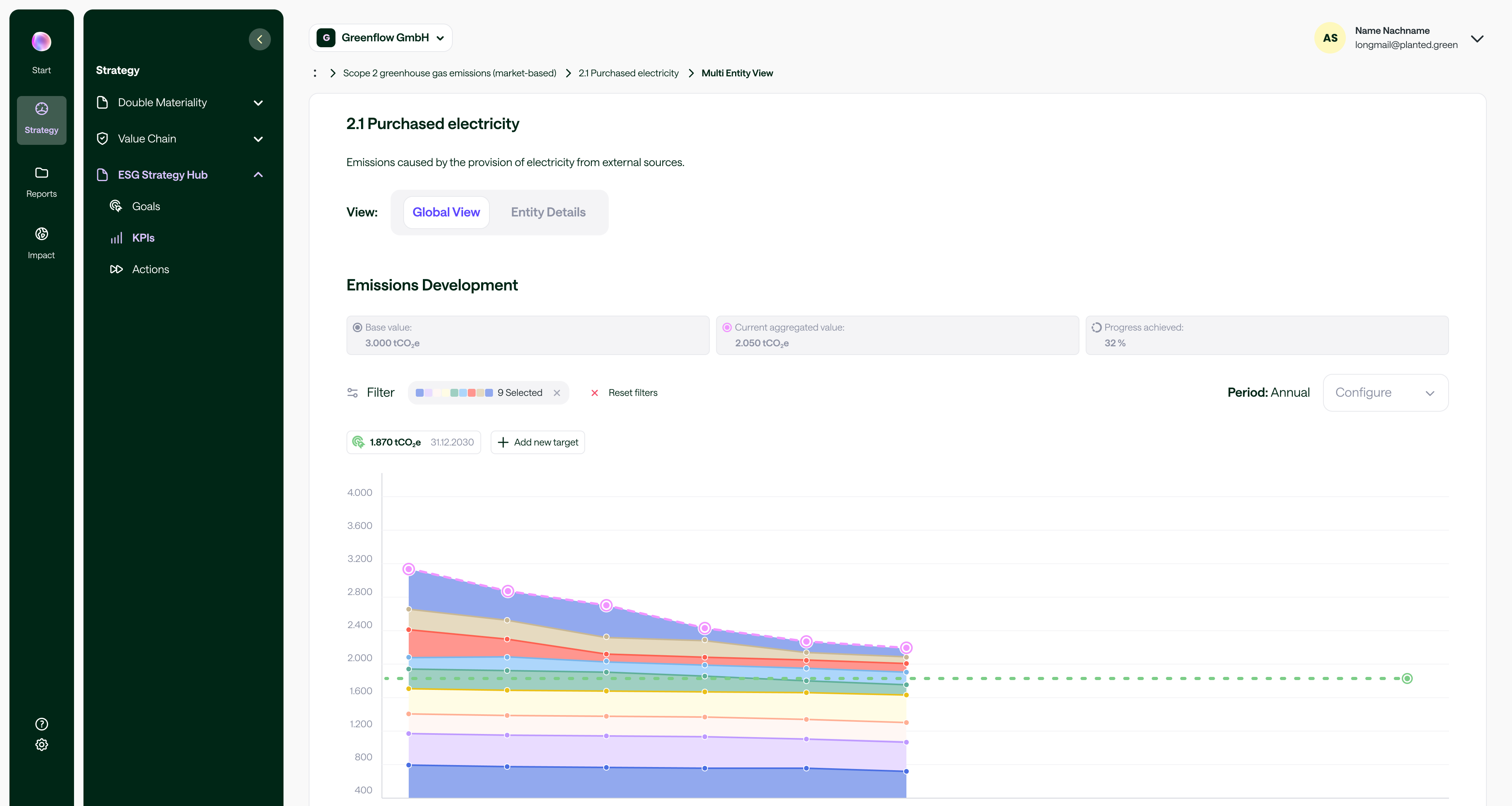
Scaling Across Multiple Entities
🧗 Challenge
Enterprise customers needed visibility across subsidiaries, business units, and locations without sacrificing clarity.
✨ Approach
Multi-entity experiences were designed to balance aggregated insights with detailed operational visibility, supporting both strategic and local decision-making.
Turning Data Into Decisions
🧗 Challenge
Large volumes of ESG data made it difficult to identify priorities and understand progress.
✨ Approach
Dashboard and reporting experiences transformed complex sustainability information into actionable insights tailored to different stakeholder groups.
🧩Designing for Complexity
One of the primary design challenges was not adding new functionality, but making highly interconnected ESG systems understandable, scalable, and easy to navigate. This required balancing the needs of sustainability experts, operational teams, and decision-makers while maintaining consistency across multiple modules and workflows.
⚡Outcome
- •Established structured workflows connecting goals, actions, KPIs, and emissions reduction planning.
- •Improved visibility across organizational levels and reporting structures.
- •Supported sustainability programs ranging from individual entities to complex enterprise organizations.
- •Contributed to a platform capable of addressing increasingly sophisticated ESG requirements.
🎓Learnings
Complexity is rarely solved by adding more features
The greatest improvements often came from simplifying relationships between existing concepts.
Information architecture can have more impact than interface design
Well-structured systems create clarity long before visual design is applied.
Domain knowledge becomes a design tool
Understanding ESG frameworks proved essential for making informed product decisions.
Scalable systems require consistency, not uniformity
Different user needs can coexist within a shared framework when design principles remain consistent.